From Historians to Navigators: Transitioning Your Finance Team from Reporting to Forecasting

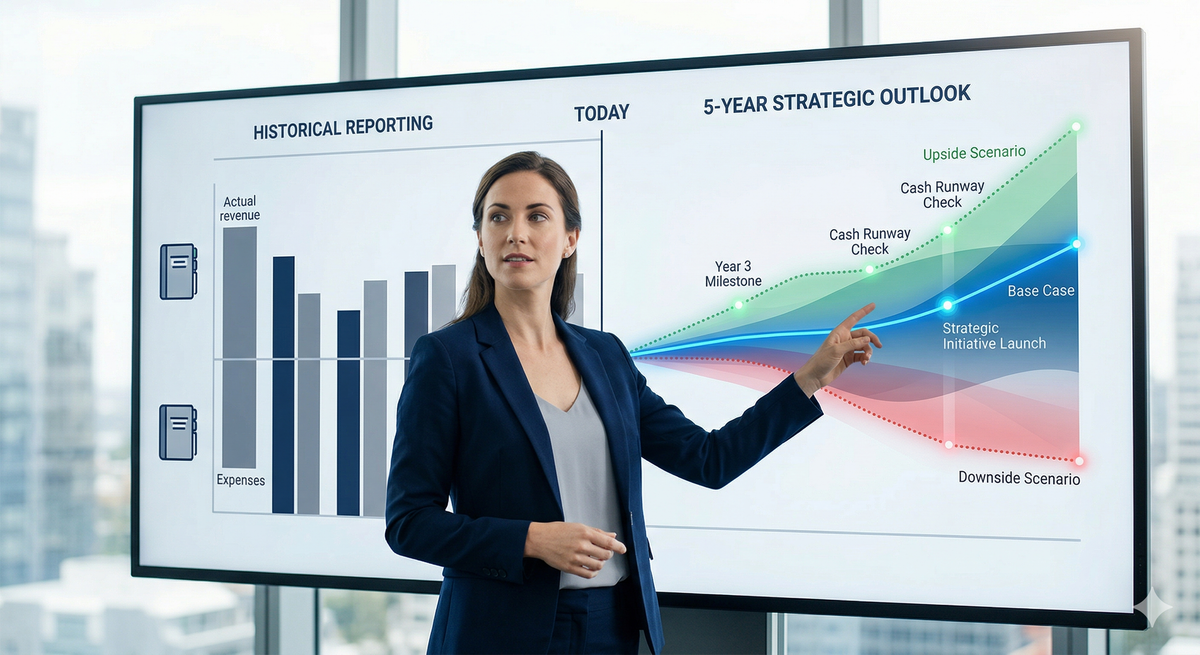
For decades, the traditional finance department has operated primarily as the organization’s historian. The focus has been on the sacred month-end close, reconciling ledgers, and producing flawless variance reports that detail exactly what happened thirty days ago. But producing perfect historical data is the baseline, not the finish line.
When you step into the boardroom to present a sweeping two-year strategy deck, the board isn't looking for a polished recap of the past. They are looking for a roadmap. They need to know if the company has the runway to launch a new product, survive a market downturn, or scale operations. This requires a fundamental shift: transitioning your finance function from a team that asks "what happened?" to a strategic powerhouse that answers "what’s next?" using robust, dynamic five-year financial models.
Here is the blueprint for leading your team through this critical evolution.
The Mindset Shift: Seeing Around Corners
The hardest part of this transition isn't technical; it’s cultural. Accountants are trained to be precise and to balance to the penny. Forecasters, however, must be comfortable with ambiguity and probability.
When you view the business from the highest level—a perspective that becomes glaringly obvious if you've ever had to step into the shoes of an acting CEO to steer the ship—you realize that leadership relies on finance to see around corners. The C-suite doesn't just need the score at halftime; they need to know the probability of winning based on the current trajectory.
To spark this mindset shift, you must redefine the team's definition of "value." Value is no longer just accuracy in reporting; value is the ability to anticipate risk and identify opportunity before it materializes.
Identifying the True Drivers of the Business
You cannot build a predictive model by simply taking last year's revenue and adding a flat 10% growth rate. That is hope, not forecasting. A world-class five-year outlook requires a deep understanding of the operational levers that actually drive the financials.
Finance teams must step out from behind their spreadsheets and talk to operations, sales, and marketing. If your company operates in a dynamic, volume-driven environment—like an auction business, for example—historical revenue is merely a lagging indicator. To predict future cash flow, your team needs to track and forecast the leading indicators: active bidder acquisition costs, average lot values, inventory pipeline, and clearance rates.
Once your team understands the operational physics of the business, they can begin to build a model that reflects reality rather than just accounting principles.
Architecting a World-Class Five-Year Model
The engine of this entire transition is the five-year financial model. This is not a static Excel workbook; it is a dynamic, fully integrated, three-statement financial simulation of your business.
- The Architecture of Assumptions: A strong model separates inputs (assumptions) from outputs (calculations). Every major driver—from headcount growth to customer churn to macroeconomic inflation—should live on a dedicated assumptions tab. This allows leadership to stress-test the business instantly by changing a single variable.
- Three-Statement Integration: Your Income Statement, Balance Sheet, and Cash Flow Statement must talk to each other flawlessly. A projected surge in sales on the P&L must automatically trigger a decrease in inventory and an increase in accounts receivable on the Balance Sheet, which then accurately hits your projected Cash Flow.
- Scenario Planning: The future is not a single point; it is a range of possibilities. Your model must be equipped with toggles for "Base Case," "Upside," and "Downside" scenarios. This allows the finance team to present the board with a comprehensive risk profile, rather than a single, fragile prediction.
Bridging the Gap: Connecting the Model to Action
A five-year financial model is useless if it sits on a shared drive collecting digital dust. Its true power is unlocked when it becomes the quantitative backbone for your immediate strategic planning.
The long-term model should directly inform your short-term actions. The five-year outlook acts as the North Star, ensuring that the two-year strategy deck you present to the board is grounded in mathematical reality. If the five-year model reveals a critical cash crunch in month 36 based on current burn rates, the strategy deck for the next 24 months must aggressively pivot toward capital efficiency or fundraising.
By connecting the macroeconomic forecast to the immediate strategic plan, finance ceases to be a back-office function and becomes the architect of the company's future.
Fostering a Culture of Strategic Partnership
Transitioning to a forecasting culture requires a new operating rhythm. The month-end close is still vital, but it should be viewed as the starting line for the real work: the monthly forecast review.
During these reviews, challenge your team to explain the why behind the numbers, not just the what. When a variance occurs, the conversation shouldn't stop at "marketing overspent by 15%." The question must be, "Given that marketing overspent by 15%, how does that alter our customer acquisition cost assumption in the model, and how does that impact our projected cash runway for the next four quarters?"
Conclusion
Moving a finance team from historical reporting to predictive forecasting is one of the most impactful transformations a Head of Finance can lead. It requires breaking the comfort of certainty, mastering the operational drivers of the business, and building dynamic, world-class financial models.
When done correctly, you no longer just deliver the news to the executive team and the board; you help write the headlines. By mastering the five-year outlook, finance transforms from a required administrative function into the most powerful strategic partner in the organization.