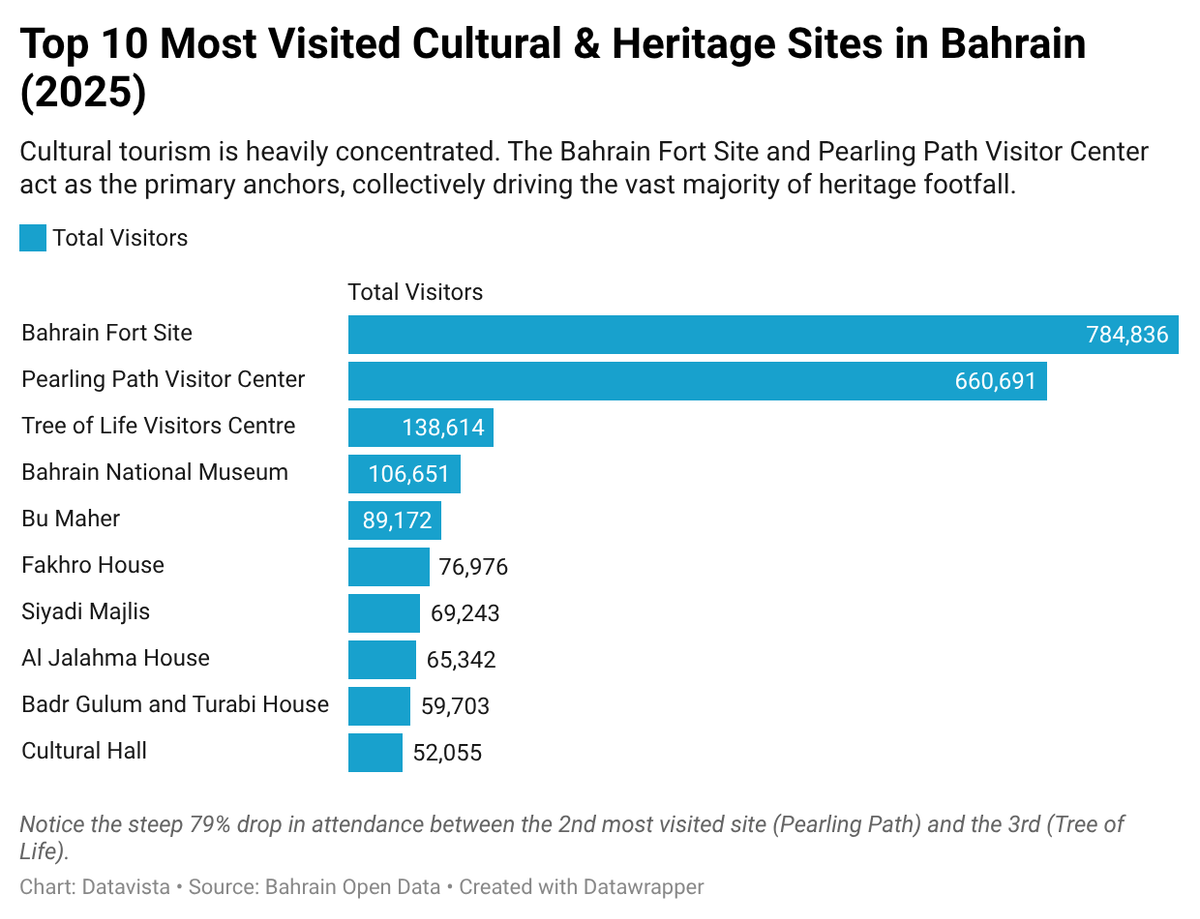
Top 10 Most Visited Cultural & Heritage Sites in Bahrain (2025)

The Concentration of Culture: Analyzing Bahrain’s Heritage Footfall
When evaluating the performance of a portfolio—whether it is a collection of financial assets or a country's cultural landmarks—we often expect to see a relatively balanced distribution of interest. However, real-world data frequently tells a different story.
A deep dive into the 2025 visitor metrics for Bahrain's top archaeological and heritage sites reveals a fascinating case study in market concentration. While the Kingdom boasts a rich, diverse tapestry of historical locations, tourist footfall is anything but evenly distributed.
In fact, it is a masterclass in the Pareto Principle.
The Duopoly of Heritage Tourism
As the visualization clearly illustrates, cultural tourism is heavily consolidated into a "Big Two."
The Bahrain Fort Site (36.8%) and the Pearling Path Visitor Center (31%) act as massive gravitational anchors for heritage tourism. Combined, they command a staggering 67.8% of the total visitor market share among the top destinations.
This level of concentration makes strategic sense. Both sites offer extensive infrastructure, high international visibility, and globally recognized UNESCO status. They are the unquestioned gateway experiences for tourists exploring the island's history.
The Challenge of the "Long Tail"
The remaining 32.2% of the pie is fractured across eight other highly significant, yet drastically under-visited, locations.
The Tree of Life and the Bahrain National Museum manage to carve out respectable, single-digit shares. However, the data gets particularly interesting when we look at the grey "5 more" slice. This category—which includes culturally vital locations like Fakhro House, Siyadi Majlis, Al Jalahma House, Badr Gulum and Turabi House, and the Cultural Hall—collectively accounts for just 16.4% of total footfall.
Strategic Takeaways
For analysts, policymakers, and tourism strategists, this visual breakdown forces a critical resource-allocation question:
- The Cross-Sell Opportunity: Do you accept that the Fort and the Pearling Path will always be the primary drivers, and instead focus infrastructure on seamlessly transporting those 1.4 million captured visitors to the smaller, secondary houses?
- The Awareness Gap: Or does this massive gap indicate a marketing failure? Are visitors simply unaware that sites like Siyadi Majlis exist right around the corner from the main attractions?
Data visualizations like this do more than just report past attendance; they expose the underlying mechanics of consumer behavior. By mapping exactly where attention is concentrated, we can move away from guessing and start making targeted, strategic decisions to elevate the entire portfolio.